Discover the waterfowl species you’ll encounter during a guided hunt with Prairies Edge Outfitting. Saskatchewan hosts an array of puddle ducks, geese, and cranes that hunters can identify in flight or on the fields.
This guide introduces Mallards, Pintails, Gadwall, Widgeon, Shoveler, Blue‑winged and Green‑winged Teal, plus Canada Goose, White‑fronted (“Speck”), Ross and Snow geese, and the iconic Sandhill Crane.
Use this article to sharpen your identification skills, appreciate each species’ behavior, and enhance your enjoyment of the hunt.
- Mallard
- Northern Pintail
- Gadwall
- Northern Shoveler
- Blue‑winged Teal
- Green‑winged Teal
- Canada Goose
- White‑fronted (“Speck”) Goose
- Ross Goose & Snow Goose
- Sandhill Crane
Puddle Ducks of Saskatchewan
Mallard (Anas platyrhynchos)
The most common species in our hunts, Mallards comprise roughly half the ducks harvested at Prairies Edge. Drakes are unmistakable with their iridescent green heads and bright speculum feathers in flight. Hens are mottled brown with a dull orange bill and a subtle blue speculum.
Mallards feed heavily in harvested grain fields and small potholes, offering prime field-hunting opportunities. In flight, their wing-beats are steady and not overly rapid—ideal for Justin-precision opportunities.
The combination of volume, predictable flight paths, and field-based hunting makes Mallards a favorite among clients and guides alike.
Northern Pintail (Anas acuta)
Pintails are renowned for their elegance and speed. With long necks and tails, they appear larger in flight than they are. They’re the other half of our typical mallard‑pintail mix during hunt days.
Drakes emit a high-pitched whistle, while hens quack more coarsely. Their flight is fast and zig-zagging, often landing gracefully into decoy spreads.
Although pintail populations have declined in parts of the Prairies, they remain abundant in northern and western Saskatchewan where we hunt.
Gadwall (Mareca strepera)
Gadwall are medium-sized and preferred feeders in grass wetlands and fields. Their plumage is understated but distinguished with barred gray and subtle black patterning.
They dabble heavily in shallow wetlands and feed in harvested fields, making occasional appearances in our duck bag as nice surprises.
Gadwall are quieter and more solitary than other puddle ducks but add diversity to the hunting experience, especially in mixed flocks.
Blue‑winged Teal
These smaller teal species are fast flyers and often travel in tight, twisting flocks. Blue‑winged teal drakes feature a white crescent on the face.
They’re less common in duck bags but highly prized by hunting enthusiasts when they show up, especially in high numbers during peak migration.
In flight, teals typically arrive in bursts and often land in small potholes lined with grain, making for exciting shot opportunities near decoys.
Green‑winged Teal
These smaller teal species are fast flyers and often travel in tight, twisting flocks. Geen-winged teal have subtler plumage and teal-green wing patches.
They’re less common in duck bags but highly prized by hunting enthusiasts when they show up—especially in high numbers during peak migration.
In flight, teals typically arrive in bursts and often land in small potholes lined with grain—making for exciting shot opportunities near decoys.
Geese & Cranes of Saskatchewan
Canada Goose (Branta canadensis)
From giant honkers to mallard-sized cacklers, Canada geese dominate our goose hunts in both size classes. Recognizable by their black necks, white cheek patches, and loud “honking” calls in tight V-formations.
These geese feed heavily in grain fields from morning until evening and are typically hunted in farmland—never over lakes—ensuring calm and consistent behavior.
Field-based goose hunts deliver some of the most intense, close-range goose action and produce clean, high-percentage shooting opportunities.
White‑fronted or “Speckle Belly” Goose
Also called “Speck,” these geese are slightly smaller than large Canada geese. They boast a white facial blaze and finely barred underbellies. Highly reliable in grain fields throughout Saskatchewan.
Specks are often hunted alongside Canada geese and are especially active during mid-September to early October migrations.
Their flight is swift and precise, making placement of decoy spreads crucial to attract and pattern them well.
Snow Goose & Ross Goose
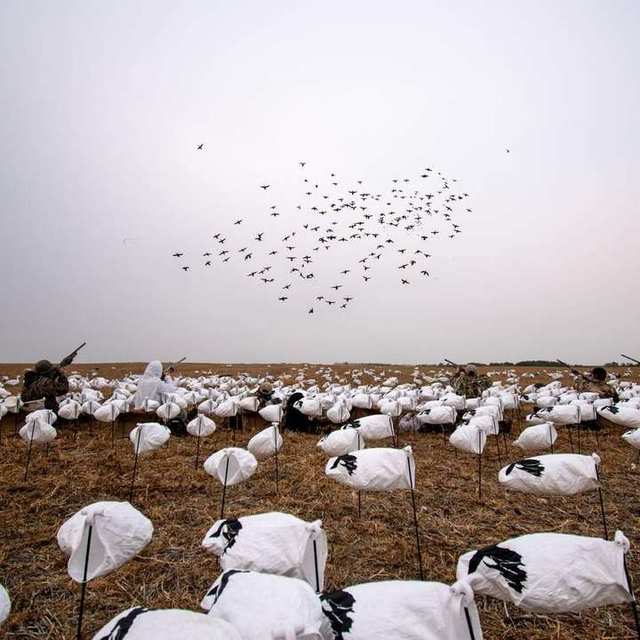
These white geese flood the skies in spring conservation hunts and arrive in late fall. Snow geese form massive roosting flocks, while Ross geese are smaller and often intermixed. Planes of snow—white geese—are stunning to see in mass migration events.
Mostly targeted in spring hunts, these lighter-colored geese offer high bag limits (up to 20 daily) and dynamic shooting experiences.
Their approach is relentless and coordinated—ideal for wide-open field hunting and conservation-focused outings.
Sandhill Crane (Antigone canadensis)
Sandhill Cranes are elegant, long-legged birds with gray bodies, red crowns, and distinctive rolling calls. They migrate through and sometimes stage over Saskatchewan’s prairie regions in spring.
Though cranes are not always present, when they are, they’re included at no extra charge during hunt packages. Our guides decoy them in the morning and then shift to ducks or geese in the afternoon for maximum value.
Crane decoy setups are strategic—requiring precise placement and scouting—but they deliver high-action opportunities when timed right.
Want to experience this firsthand?
Book Your Hunt
Read More About Waterfowl News